Font size:
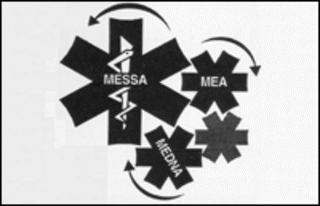
One of the unavoidable problems of taxation is that citizens may subsidize causes with their tax dollars which, given a choice, they would otherwise not support. For example, many taxpayers would not contribute to the Michigan Education Association if given this option, but they end up supporting the union since a portion of their tax bill is applied to the MEA through educational spending. In a less obvious way, taxpayers also support the MEA whenever a school district purchases employee insurance from MESSA, because a portion of MESSA's income is channeled into the MEA and its related divisions. In 1992, for example, after MESSA paid for benefit costs, 35.4 percent of its remaining revenues were paid to the MEA and the Michigan Education Data Network Association in the form of "service fees."104
In effect, the MEA is receiving an annual "commission" for representing MESSA in contract negotiations with school districts. The commission (or service fee) supposedly encompasses all of the costs incurred by the MEA while bargaining on behalf of MESSA, marketing MESSA programs to its members, and representing MESSA's interests in the political arena. Yet, the bulk of MESSA's service fees-84 percent in 1992 are paid to MEDNA in exchange for various clerical services. Astute observers have questioned this whole financial exchange, noting that while MESSA and the MEA cannot accumulate profits, MEDNA has "for-profit" corporate status.
The practice of purchasing services from related corporations is not unusual. In fact, it is a legitimate way to transfer funds between corporations so that one has more available cash. With MESSA, the MEA is given an additional source of income independent of member contributions. MEDNA, on the other hand, makes it possible for the MEA to access a powerful computer system and other shared resources that would be nonexistent but for MESSA. MESSA owns a massive network of computers, MEDNA operates the system, and the MEA is given access to the computing resources as well as the information contained within MESSA's database. Rather than purchase its own comparable resources or lease them directly from MESSA, the MEA has pooled interests with MEDNA.
There are numerous questions which need to be answered with regard to the MEA financial network. How are these transactions affecting public education? What does it mean to taxpayers besides indirect financial support of the teachers' union? For what purposes are the MEA and MEDNA using the money they receive from MESSA? The answers can be found in the actual transactions between the MEA, MESSA, MEDNA and MEA Financial Services.