Search
Login
Register

State superintendent launches plan to grade schools

Critics: Timid plan a "mockery of accountability"

Fri., February 15, 2002

On Dec. 10, 2001, State Superintendent of Public Instruction Tom Watkins unveiled "Education YES! A Yardstick for Excellent Schools," a plan designed to keep Michigan public schools accountable for the quality of education they deliver.

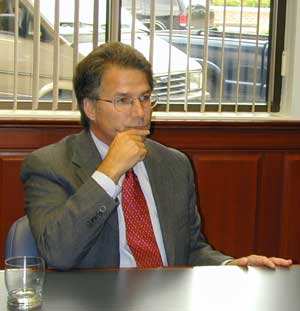
State Superintendent of Public Instruction Tom Watkins launched a new school accountability plan in December. The plan, called "Education Yes! A Yardstick for Excellent Schools." will include school report cards.

The plan comes months after Watkins and the State Board of Education abandoned a previous accountability model drafted by former State Superintendent of Public Instruction Arthur Ellis.

Though it remains to be seen how the evaluation criteria for the accreditation system will be crafted, the plan features an annual letter grade for Michigan public schools, which includes charter schools. The grades will be based on a combination of student Michigan Educational Assessment Program (MEAP) test scores, staff development programs, student attendance, and level of parental involvement. The plan will go into effect beginning with the 2002-03 school year, and the first official grades will be posted after a year of evaluation.

Watkins emphasized three goals for Michigan schools: first, that all elementary and middle school students read and compute at their own grade level; second, that all students demonstrate a year's academic growth in a year's time; and third, that all high school students follow an education plan tailored to their post-high school goals.

"We're trying to hold schools accountable in a fair and reasonable way," Watkins said. "We're calling for having grades-A through E-because it's easily understandable [with] `E' representing a failing grade."

"This will be controversial," he added.

Out with the old, in with the new

Letter grades aren't the only controversial thing about the Watkins plan. Some critics are charging that the plan does not do enough to hold schools accountable and that the abandoned Ellis plan would have done a better job.

"[Watkins's plan] makes a mockery of accountability, leaving millions of parents and taxpayers in the dark about Michigan's growing achievement gap," said Greg McNeilly, director of Choices for Children, a Grand Rapids-based education reform group.

The Ellis plan would have implemented a three-part accreditation system for schools, using the MEAP as a benchmark. Under this plan, schools would have been required to have at least 80 percent student participation on the MEAP, and would have received different levels of accreditation based on the number of students performing well on the MEAP. Schools with less than 25 percent of their students demonstrating proficiency on MEAP would have been "unaccredited" under the Ellis plan. Nearly 1,000 Michigan schools - or about a third - would have been unaccredited under the Ellis plan.

Defining accountability

In May 2001, Watkins defended his decision to craft a new accountability plan, saying the Ellis plan unfairly designated too many schools as "unaccredited." Watkins negotiated with Ellis to withhold the list of unaccredited schools until Watkins could establish the "Education YES!" plan, which does not classify any schools as unaccredited.

Some observers note that the Watkins plan's effectiveness will be difficult to measure from one year to the next, especially when some of the plan's components include things that are hard to evaluate, such as parental involvement.

Addressing a November 2001 Michigan Association of Public School Academies conference, Lawrence Reed, president of the Mackinac Center for Public Policy, told a crowd of charter school parents, teachers, administrators, and supporters that accountability to parents is the ultimate measure of accountability in education. He challenged Watkins, who was present, to embrace reforms that would put the focus of education on children, parents, and more educational choices and encourage multiple educational options that he said could better serve a diverse population rather than a "one-size-fits-all" system.

As part of the release of the new accreditation program, the Michigan Department of Education is holding hearings around the state to introduce the program to teachers, community leaders, and citizens and to solicit feedback on how best to implement the system.


Michigan Education Daily
"Increased energy, health care and retirement costs, coupled with declining enrollment and uncertain state funding, have pushed a number of public school districts into the red." >>
"More students will earn high school credit online and off campus in Michigan in 2009 due to a pilot program allowing some school districts to bypass "seat time" requirements." >>
"Southfield Public Schools wants to freeze teacher wages but offer educators lump sum payments if enrollment improves." >>
"Health insurance is a key issue in stalled teacher contract negotiations in dozens of Michigan school districts, with arguments over union-affiliated insurance generating talk of teacher strikes." >>
"School closing discussions are under way in Flint, Pontiac, Bloomfield Hills and Bullock Creek." >>
"Mount Pleasant Public Schools will join other schools in the area to explore forming a health insurance pool." >>
"A work group studying education spending in Michigan will recommend eliminating the Michigan Promise Grant in view of a projected $1.1 billion state budget shortfall by 2012." >>
User Comments
Treatment centers offer <A HREF=http://www.teenageproblems.net/>struggling children treatment </A> in effective and real sense. Center provides expert and professional medical expertise that have years of treatment experience. Center develops spiritual qualities in youths. They encourage teens to become descent.

http://www.teenageproblems.net/
>>
For me, either public or private could give good education to students. It really doesn’t matter whether you are in public or private school as long as you are studying and obtaining education, and providing that you can afford the expenses. One of the key ingredients to the success of a modern nation is education. As Americans emerge from the afterglow of the recent presidential elections and president-elect Obama prepares to take the reins of the country, education is a topic on the minds of many. What will he do to improve the lot of students and teachers in America? According to an article at The Apple, Obama’s first order of business when it comes to education will be to look at No Child Left Behind. He doesn’t want to scrap the program, but he does want to reform it, particularly when it comes to standardized testing. He does not support preparing students all year to “fill out bubbles.” Referencing schools, both Obama and vice president-elect Joe Biden support charter schools, as long as they perform up to standard. Teachers at charter schools and others are pleased with Obama's incentives like Teacher Service Scholarships and various pay rewards – this will certainly be a great help. Furthermore, part of the president-elect’s main concern is to boost Early Head Start programs and provide tax credit for college education. The course to repair faith in the American educational system through these ideas and more will definitely lead to the kind of credit repair the country needs. Click to learn more about <a title="What is Credit Repair?" href="http://personalmoneystore.com/moneyblog/what-is-credit-repair/">Credit Repair</a>. >>
Now a days most of the parents are looking to join their childerens in private school. Because parents are thinking ,Government would not provide good fecilities . And also promoting good teachers, Government never concerned about the good quality schools and techears. so most of the parents interesting to higher in private schools.
================================================

johnson

<a href=" http://www.addictionlink.org/drug-rehab-center/michigan">michigan drug rehab</a> >>
Testing is not the answer. All it does is give the "teacher" a basis for determining a grade. And, we all know that grading and grades are circumspect. Rather, a more true measure of learning is when the learner (i.e., the "student" using traditional and aniquated terminology and stereotyping) wants to know more about a topic or issue. This expression of desire for more is an affirmation that the learner has mastered current concepts and material and now wants to move on. In this scenario no test nor grade is necessary. What should be necessary is for the provider (i.e., the "teacher") to have the next level or dimension of concepts and materials readily available to present and apply once the learner expresses the desire to move on.

What we need is a system that is designed to cater to this basal learning behavior and can be applied in real time. Take a look at the definitive treatment "Education in America -- What's to Be Done?" developed by Trigon-International. This commission report presents an end-to-end solution that is actionable and affordable. >>
$400 K, try $400 million >>
Thank you to Lorie Shane and Marcie Lipsitt for blowing off the cover, exposing one of Michigan's "dirty secrets."

As the parent of a child with special needs in Michigan, it's been an uphill battle since day one to get the APPROPRIATE services for my child. Sadly, the bar is held too low for our kids. Upon graduating, if the student is not capable of attending college, he/she is warehoused into post-secondary settings where formal academics are not offered. Perhaps if students had gotten proper academics when younger- taught by highly qualified teachers- many would have had the opportunity to move on and continue formal academics like their non-disabled peers, rather than be expected to dust shelves and bag groceries their whole lives.

Michigan's special eduation has and continues to fail our children.

>>
As a parent I see the value of a teacher with knowledge of both special ed methods and the subject matter. Do enough of them exist to go around? My guess is that many teachers who concentrated their schooling and training on special ed took fewer courses in subject matter (English, Mathematics, Science, etc.). There are limits on course load, number of years in college, and student finance.

As much as we want the best for every person, we are not going to have six teachers each an expert in their subject matter per one pupil. So in this world of limited resources, each person and our society have to decide how to use the resources we have. Hopefully a successful balance of flexibility and accountability can produce the desired results: educated children with the capacity to think and the ability to learn. >>
Michigan High School & the University deliver quality education to its
students & has maintained its standard with good caliber. The courses offered by the Michigan institutes are versatile and for future progress of the society and the students, it further enhances them to become excellent citizens!!
---------------------------
Carol
<a href="http://http://www.treatmentcenters.org/michigan">Michigan Treatment Centers</a>
>>
Thank you for your comments. I would be honored and proud to go to any school district or meeting to stand up for your/our children!! Just EMail me and I will be there or call me anytime at 616-8474282
Thank You, Dr Jack Grenan Educator and Cancer Survivor >>
Parents and teachers have not had a voice. The waivers used have allowed administrators of various Michigan schools to plunk in 20 - 25 students in a classroom of students with learning disabilities. As a special education teacher, I find it very difficult to meet the individual learning objectives of that many students. >>