


 Font size:
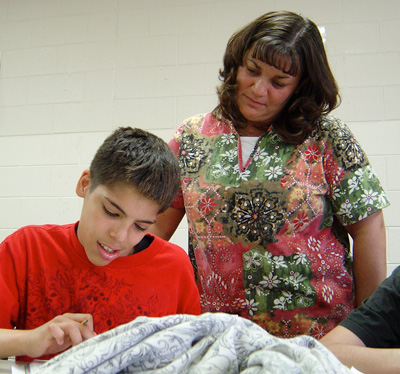
Evan Geiersbach wants to be an electrician some day. He knows he will need some background in math, but he doubts he will need to know how to graph linear equations. Michigan policy makers have decided differently, and that’s why Geiersbach and many of his freshman classmates are required to spend an hour a day after school in a tutorial program at Pinconning High School, trying to catch up on their algebra, English and social studies.
As Michigan raises the bar on high school coursework, public school districts are spreading safety nets to catch students like Geiersbach who can’t quite reach it. Extra help? It’s available before, during or after school. Homework question? Try the teacher’s online hotline. Borderline grades? Mandatory math club awaits.
And when all else fails, including the student, school districts are offering second chances through summer school and online courses.
Schools have always offered help to struggling students, but academic assistance and credit recovery, or make-up courses, have taken on greater importance with Michigan’s new high school graduation requirements. With every student required to complete four years of math and English, including algebra, geometry and algebra II, and three each of science and social studies, one failed class can derail graduation.
At the same time, the content of those courses has become more rigorous under the state’s new content expectations, meaning freshmen today are learning concepts once reserved for juniors or seniors. State officials say that students need more rigorous high school work in order to succeed in postsecondary education, leading to higher earning potential and a better-educated Michigan workforce.
While acknowledging those goals, local school officials are left to figure out ways to help students succeed in classes they once might have avoided.
"We’re trying to make all kids successful," Pinconning algebra teacher Kristin Chase said, but she acknowledges that her first reaction to the new math requirements was that, "Not every kid is cut out for this curriculum."
As a teacher, she is now required to cover more content per class period in the past, and says that some students can’t keep up.
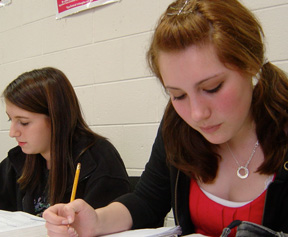
That’s how ninth-grader Candace Renshaw sees it, too, she said as she and friend Kristen Ott worked on algebra homework.
"It’s easy to learn, but it’s a lot. We have to learn it the first time we hear it," she said. "I ask my (older) friends for help and they don’t even know how to do it. They should have at least prepared us in middle school, if they knew we were going to be guinea pigs."
UPPING THE ANTE
"The ante has definitely been upped," Principal Jason Hamstra at Summit Academy High School in Romulus told Michigan Education Report. At 480 students, the school is one of Michigan’s largest charter public high schools. "By March of their junior year, you’ve got to get a lot of algebra into them."
March is the month when juniors take the Michigan Merit Exam, the standardized test that helps determine whether a school meets the requirements of the No Child Left Behind Act. Graduation rates are another factor, and only students who earn a diploma within four years can be counted as graduates.
"Once you hit the ninth grade, that clock starts ticking," Hamstra said. About 25 percent of his students need extra academic help, he estimated. Half of the high school’s students come from Summit’s own elementary programs, but the rest come from a number of conventional public school districts, and some are better prepared than others. If classroom intervention isn’t enough to help students who fall behind, the school follows up with credit recovery through summer school and online courses, Hamstra said.
In Pinconning, "We looked at the new curriculum and knew we needed to develop some new initiatives," Mike Vieau, assistant superintendent, said. Three weeks into the school year, freshmen with failing grades in core content classes were told they must attend an after-school assistance program.
The district pays the current teaching staff for the extra time and also pays for an extra bus run to take the students home.
"We’ve had to incur more cost," Vieau said, but he believes that will be offset by keeping students in school until they graduate.
Similarly, Shepherd High School science teachers have developed a pilot program under which students must stay after school or give up their lunch period to make up missed homework.
"(Missed) Homework is a huge reason kids fail," Shepherd Principal Doug Bush said. Teachers already are seeing a decline in missed assignments, he said.
Shepherd also has an after-school program staffed by teachers on a volunteer basis and is reviewing its summer school program. The district has developed a "failure profile" to help figure out which students fail and why, and then creates interventions to help them.
"These teachers have said, ‘I’ll spend time with you even if it’s not in the contract,’" Bush said of the after-school program, but added, "I can’t predict whether that will continue." If the program proves successful, he said, perhaps the district will budget funds for it in the future.
TWEAKING SCHEDULES
Adding time to the school day or shifting to a trimester schedule are two of the most popular responses to the new high school curriculum.
Under the most traditional high school schedule, the school year is divided into two semesters and students take six classes per semester, or 12 per year. A trimester plan splits the year into thirds, with students taking five classes per trimester, or 15 per year.
Under the semester plan, students earn one math credit by taking algebra for a full year; in the trimester plan, they earn one credit by completing algebra in two-thirds of a year, leaving them one-third of the year to take a different class. That class could be an elective, or, for struggling students, a time to catch up.
"A student could fail algebra in the fall, take that class again, and take the second half of algebra in the third trimester," Bush pointed out. "They might lose an elective, but at least on core subjects they stay on track."
Shepherd switched to a trimester schedule this year, and has been able to help most students pass their first year of algebra and English, he said.
"Under a six-period day (the most common high school schedule) you had no fudge room," Mount Pleasant High School Principal Jeffrey Thoenes agreed. If a student failed algebra, he or she would have to either take a make-up course or take both algebra and geometry as a sophomore.
Students who complete algebra or English in two-thirds of the year spend less time on it than they would under a semester schedule, but Thoenes and other educators said they believe students will learn just as much. Since there are only five classes per day, each class period is slightly longer. That creates certain efficiencies, Thoenes said, such as only needing one day to set up and carry out a science experiment.
At the same time, those students now have room in their schedules for more electives.
"We’re offering (elective) classes we never offered before," Thoenes said, naming forensic science as one example. "We’re expanding our Advanced Placement options. You aren’t going to hear me complain about the new state mandates."
CREDIT RECOVERY
Michigan schools also are preparing for cases when, despite intervention, students fail a required class.
The public school districts that make up the Gratiot-Isabella Regional Educational Service District plan to offer as many as 30 to 40 credit recovery courses jointly this summer, according to Deborah Dunbar, GRESD associate superintendent for instruction.
Students can take classes at any participating high school, choosing day or evening classes to fit their own schedule. Each high school will grant credit to its own students regardless of where the class is taken.
"This is our first attempt at taking a regionalized approach," Dunbar said, a plan that makes sense to Alma High School Principal Don Everhart.
"If I’ve got three kids that need chemistry, can I find it in my budget to run summer school for chemistry? Frankly, that would be hard to do," he said.
But traditional summer school isn’t the only choice for students who need to retake a course. Online classes and, less frequently, correspondence courses, are alternative ways to take courses in the Gratiot-Isabella district. The same is true in hundreds of high schools across Michigan.
Credit recovery accounts for about one-third of the enrollment in Michigan Virtual School, according to executive director Robert Currie. A nonprofit corporation established by the state to foster online education in Michigan, the program offers courses to public, private and home-schooled students. Students enroll through their schools or, in the case of home-schoolers, their parents, and can access the class from any computer.
Some students take online classes during the regular school day, using school computers, but others log in after hours from home or a public library computer center.
Similarly the Genesee Intermediate School District brokers with eight vendors to offer more than 600 online classes through a statewide partnership among Michigan’s Regional Education Media Centers and other intermediate districts. Thirty-four school districts participated in the online program this year, from River Rouge to Mackinac Island to Battle Creek.
Some students enroll in order to make up required classes, like algebra, but others are looking for advanced placement or honors courses that their own school doesn’t offer. Still others want to take general education classes at unusual times, according to Beverly Knox-Pipes, assistant superintendent.
The most utilized vendor - and the least expensive - currently is Brigham Young University, with 683 Michigan registrants as of May. BYU offers 182 courses. Other vendors include the University of Nebraska, Aventa Learning, Florida Virtual School and Virtual Greenbush, based in Kansas. All of the vendors are accredited, Knox-Pipes said. The local school district must agree to provide a local mentor, sometimes a teacher but often a counselor, to help facilitate the process, but not actually teach the material. The local district must approve the course and ultimately grants the credit.
The Genesee Intermediate School District also administers a distance learning program through which pupils in one of its constituent districts can take a class from a teacher in another district through interactive television. The teacher can see, hear and send information to the students at the remote locations and vice versa. The ITV program not only makes general and advanced classes available to students — American Sign Language is a popular choice — but also meets the new requirement that students have an "online experience" during high school.
Specialty courses and Advanced Placement courses were the roots of the Michigan Virtual School as well, according to Currie, intended to help districts without the resources to offer them. The program still offers those courses, but more core content like algebra and social studies have been added to help students who failed the classroom version.
"We get a fair amount of seniors needing U.S. government credit," Currie said.
"We need to be a leader for schools in assisting them in finding these solutions," Currie said. In the past 18 months, his staff has redesigned its online courses to match the state’s new content expectations. At the same time, they developed tutorials for teachers.
"All of a sudden every one of our kids is going to take Algebra II," Currie said. "Some people are going to teach classes they haven’t taught in a while."
ONLINE OR FACE-TO-FACE?
Whether a student fares better in an online environment or in a traditional summer school depends on the student and the course, educators said.
"My feeling is that a child who struggles early on will do better with a hands-on approach with an engaging teacher," said Dunbar, herself a former special education teacher.
Similarly, Everhart said, "I would want to have a student in front of a teacher as much as I could."
Yet Michigan Virtual School regularly receives testimonials from happy parents about students who failed in the classroom, but succeeded in an online setting.
"The student is much more in control of their learning," Currie said. "That can be good or that can be an extreme challenge."
"Is (online coursework) a magic pill? No, it isn’t. It requires them to be dedicated and motivated."
Dedication and motivation are two of Patrick Fellows’ problems, the freckled Pinconning ninth-grader admits candidly.
"I have trouble doing assignments," he said as he completed a worksheet for English class about "Romeo and Juliet." "I’ve been getting 90 percent on the tests, but the homework is killing me."
###
Lorie Shane is the managing editor of the Michigan Education Report, the Mackinac Center’s education policy journal. Permission to reprint in whole or in part is hereby granted, provided that Michigan Education Report is properly cited.

The Mackinac Center for Public Policy is a nonprofit research and educational institute that advances the principles of free markets and limited government. Through our research and education programs, we challenge government overreach and advocate for a free-market approach to public policy that frees people to realize their potential and dreams.
Please consider contributing to our work to advance a freer and more prosperous state.


