Search
Login
Register

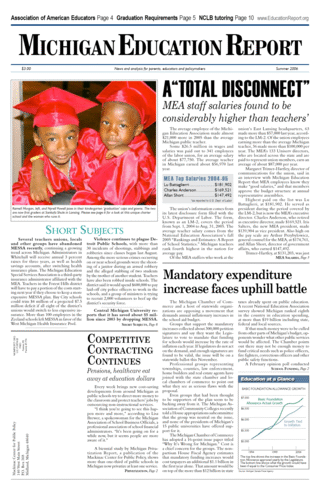
A "Total Disconnect"

MEA staff salaries found to be considerably higher than teachers’

Thu., May 25, 2006

The average employee of the Michigan Education Association made almost $21,000 more in 2005 than the average Michigan public teacher.

Some $26.5 million in wages and salaries was paid out to 341 employees of the labor union, for an average salary of about $77,750. The average teacher in Michigan earned about $56,970 last year.

MEA Top Salaries 2004-05

Lu Battaglierri

$181,902

Charles Anderson

$169,521

Allan Short

$147,492

The union’s information comes from its latest disclosure form filed with the U.S. Department of Labor. The form, known as an LM-2, covers the period from Sept. 1, 2004 to Aug. 31, 2005. The average teacher salary comes from the National Education Association’s fall 2005 "Rankings and Estimates: A Report of School Statistics." Michigan teachers rank fourth highest in the nation for average pay.

Of the MEA staffers who work at the union’s East Lansing headquarters, 63 made more than $57,000 last year, according to the LM-2. Of the union employees earning more than the average Michigan teacher, 36 made more than $100,000 per year. The MEA’s 133 Uniserv directors, who are located across the state and are paid to represent union members, earn an average of about $87,000 per year.

Margaret Trimer-Hartley, director of communications for the union, said in an interview with Michigan Education Report that MEA employees know they make "good salaries," and that members approve the budget structure at annual representative assemblies.

Highest paid on the list was Lu Battaglieri, at $181,902. He served as president during the period covered by the LM-2, but is now the MEA’s executive director. Charles Anderson, who retired as executive director, made $169,521. Iris Salters, the new MEA president, made $139,904 as vice president. Also high on the pay scale are Arthur Przybylowicz, general counsel for the MEA, at $174,761, and Allan Short, director of government affairs, who earned $147,492.

Trimer-Hartley, at $131,203, was just behind Jolene Kelly, director of finance, at $134,153, and Thomas Ferris, one of three people the LM-2 identified as the MEA’s director of human resources, at $134,144. Robin Langley, also listed as director of human resources, made $134,864, while Thomas Baird, another employee listed as director of human resources, made $126,282.

Some educators, however, do not feel that dues money should go toward funding such a large operation.

"It’s a tough pill to swallow," said Heather Reams, director of communications for the Association of American Educators. "It’s really a slap in the face to teachers, when union staffers make two and three times as much money."

The MEA, however, defends its operation.

"We work hard to give our members their money’s worth," Trimer-Hartley said. "They value the service this organization provides."

Chris Card, a 13-year teaching veteran in Webberville, said he thinks there is a "total disconnect" between what teachers make and what MEA staffers are paid. (See related story, page 4).

"I can’t see how they can even relate to us," said Card, who resigned from the MEA last fall. "We have a kid who comes to us and can’t go on a field trip, we take the money from our own pocket and make it happen.

"But they’re living a whole different lifestyle off what they’re pocketing from our dues," Card said about the amount paid to union staff. "They’re in a whole different place. How can they represent us?"

When asked how teachers and support personnel learn about the salary and budget process in order to vote, Trimer-Hartley said the union has an "elaborate, extensive structure" by which it provides information. Teachers must pay about $570 a year in dues to the MEA to fund that structure, while support personnel must pay half that amount. A part of that money is then sent to the National Education Association.

"It’s difficult to see a portion of your salary go to dues," Trimer-Hartley said. "But until they were increased, they were frozen for six years."

In a February 2003 memo, the MEA told members a dues increase was necessary to erase a budget deficit caused by a drop in pension assets, a decrease in investment revenue and an increase in the retirement fund liability for MEA employees.

The MEA’s investments earned $1 million interest last year, according to the 2005 LM-2. Sale of investments and assets brought in another $2.6 million. Of the union’s $123.8 million in total receipts, $64 million was from dues and fees. In addition to staff salaries, however, the MEA also paid out $1.5 million in deferred compensation and $2.5 million in prepaid retirement costs for its own employees. These amounts were not broken down by individual recipient.

"It takes a decent salary and decent benefits for us to be competitive and get the best and the brightest," Trimer-Hartley said.

A new dues structure, one based on taking a percentage of what teachers and support staff earn, could be implemented this fall. Trimer-Hartley said no dollar amount has been set as a threshold for what the MEA will collect under the new system, but a cap will be in place for the maximum amount members must pay.

"We aren’t operating a savings and loan," Trimer-Hartley said. "We will only take in what we need to meet the services we are expected to deliver."

Other information gleaned from the union’s LM-2 show the MEA has $58.9 million in assets, including $29.7 million in cash.

Michigan Education Daily
"Michigan voters could see an education funding question on the ballot this year if the state Legislature doesn't take action on the issue." >>
"In an apparent flap over who is allowed to book time on the school board agenda, the Novi Education Association said that if it can't bring in a representative from the Michigan Education Association to speak at a board meeting, then it will hold a community meeting of its own." >>
"More high school students than ever are taking Advanced Placement tests, but the failure rate is increasing as well." >>
"Nine southeast Michigan school districts paid $25,000 each to be named a "top school district" in Michigan by a Detroit-area public relations firm." >>
"Two former Detroit Public Schools employees accused of defrauding the district of $400,000 in a payroll scam pled guilty in federal court." >>
"Students rallied outside Pontiac High School last week to protest the layoffs of 15 teachers, but comments made by one student suggested that the youths also disagreed with teacher seniority rules." >>
"In a bid to reduce state spending by up to $450 million, Gov. Jennifer Granholm has proposed modifying the pension and health care plans for future school and state retirees, but also would offer an incentive to any who retire this summer." >>
User Comments
Is it true that young ones today are losing interest on these subjects? Obviously, the White House is promoting programs that will help students on coping up with math and science subjects. But, The federal government thinks that the quality of math and science education can repair credit with the scientific community and improve US education with a few <a rev="vote for" title="U.S. Government Spends $250 Million on Science and Math" href="http://personalmoneystore.com/Payday-Loans/ ">payday loans</a> of sorts. In reality, it will take far longer to accomplish than they might think – US educators can't even get students to accept that "irregardless" isn't a word, and the difference between their, they're, and there – our students can't even learn their own language! It's a noble aim, to be sure, but throwing money at it may not work in the long run. >>
I am a teacher in the same county who is presently trying to quit the union. Like Caldwell, I strongly disagree with the MEA.

This article was timely.

Rob Olson
Pittsford Area Schools

>>
I agree this is a change worth making. I describe some of the uneven effects of the idea on my blog at http://rickolson.blogspot.com/2009/08/statewide-health-insurance-plan-for.html which you may also wish to read.

The devil will be in the details, so this is one we will need to monitor closely.

Rick Olson from Saline, former school Business Manager >>

Nowadays, saving money is very crucial and properly investing the money can keep you and your family away from the effect of the financial crisis. The sad news is that a lot of the options for short term funding have been drying up. Short term funding is a necessary thing to have around, and going through traditional channels such as banks isn't an option for a lot of people anymore – basically it's only open to Ken Lewis. Installment loans are an option, but some people, including senior citizens, have been thinking about raiding their retirement fund. Getting into your pension retirement plan or 401(k) funds is the last thing you want to do if you don't qualify for any withdrawals yet. The penalties are substantial, and you'll end up needing installments loans to pay them if you use retirement funds for <a rev="vote for" title="Installment Loans Reliable Option As 401(k)s are Dwindling" href="http://personalmoneystore.com/moneyblog/2009/05/17/installment-loans-reliable-option-401ks-dwindling/">short term funding</a>.


>>
I AGREE >>
Godfrey-Lee on the west side of the state has been running all-day, every-day kindergarten for several years. >>
We have a problem in Detroit Public School, their system had cash flow problem for years now. And honestly it getting worst in terms in progression with more children leaving to charter their schools almost every year. The state decided to give the Detroit school districts cash advance of $70 million so they would meet the schools expenses, as well as payment for teachers. Robert Bobb, the newly appointed emergency financial manager, requested the funds early in order for him to get the house in order before he had to start panicking. President Obama has been giving out large sums of money for troubled school districts, perhaps that’s where a generous portion of the aid came from. Getting Detroit Public Schools in working order is a worthy cause.

LINK TO READ FOR MORE INFO:
http://personalmoneystore.com/moneyblog/2009/03/10/state-advance-detroit-public-schools-70m/


>>
I am all for school choice and think its great that charters are finally moving forward. However, I'm wondering if the research accounts for a playing field that is not level. I can't take my school buildings and move them anywhere I want, nor can I simply slap up a pole building and make it a school. If anything, public schools need less state regulation and oversight so we can play by the same minimal rules charters do. If you want public schools to compete to improve, remove the barriers to doing so. I will gladly except less funding per pupil if the playing field is level.
>>
The purpose is to encourage non excercising children to excercise but my daughter's highschool gave her an improper body fat percentage and made my healthy daughter who trains 20 hours a week in tap jazz and ballet believe she was overweaghit instead of a person with muscles.
I believe the public schools do not have the right to make the diagnoses with these kids because they are using one measurement and recording it from their arms that they have a certain percetnage of body fat with one arm caliper test.
Does any one have feed back?
>>
Specifically, 81 percent of students in religiously affiliated schools and 82 percent of students in other private schools have parents who report being "very satisfied" with their schools, compared to 55 percent of students in assigned public schools and 63 percent of students in chosen public schools.

High levels of satisfaction among private school parents also extend to opinions about their children's teachers, academic standards of the school, order and discipline at the school, the amount of homework assigned, and interactions with school personnel.

http://fitt.in >>