Remember the education stimulus?
Back in the early, heady days of 2009, President Barack Obama made headlines across the country by announcing he would pump $100 billion into public education for two reasons: jobs and reform.
"We know our schools don't just need more resources; they need more reform," he told Congress in February 2009.
The American Recovery and Reinvestment Act was expected to bring about that reform. The cash windfall would allow schools to try new teaching methods, figure out how to evaluate teachers and principals, begin to use test data wisely, and finally do something about failing schools.
Will "small schools" improve test scores? Use stimulus funds to find out. Extended school day? Online classes? Merit pay experiments? The stimulus will pay. Hiring people for all that innovation was expected to boost student achievement and create jobs as well.
That's not how things turned out in Michigan. Rather than "extra" dollars, most stimulus cash went to fill holes in Michigan's own education budget, leaving overall school funding essentially unchanged in 2008-2009 and slightly lower in 2009-2010.
Reports on how schools have used the stimulus money to date show that most of the money has gone to retain existing teaching jobs and programs.
The reform side of "jobs-and-reform" may still happen, but, ironically, Michigan is likely to see more change brought about by its efforts to secure $500 million in "Race to the Top" funds than it will from the more than $1 billion that the state received without having to compete.
One exception may be stimulus money targeted at disadvantaged and special needs students. Those smaller pockets of money are being used more frequently for professional development or short-term tutoring aimed at raising student achievement in the long run, according to interviews with school administrators.
STABILIZATION DOLLARS
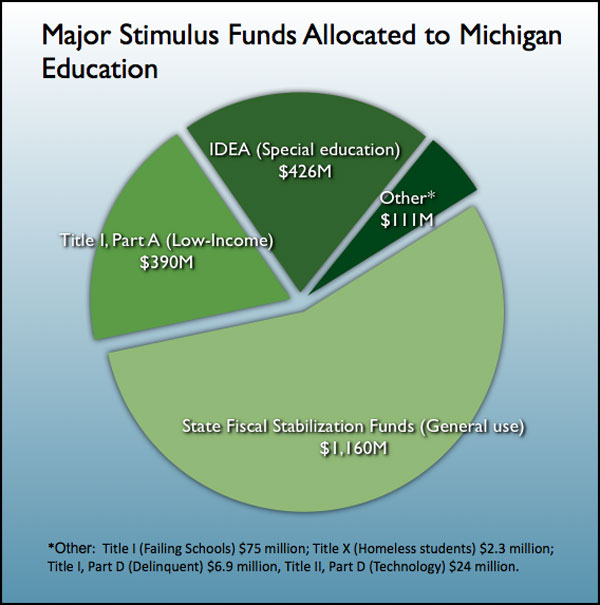
Of all the education stimulus dollars allocated to Michigan, the $1.16 billion called "State Fiscal Stabilization Funds" is by far the largest slice of the pie. While those funds can be used for any activity allowed under the Elementary and Secondary Education Act, about 80 percent of Michigan school districts have used the bulk of their share so far to retain teachers, according to a December report from the General Accounting Office.
Michigan's own report showed that, as of Sept. 30, schools reported about 12,545 jobs "created or retained" with stabilization dollars. Some districts also reported using the money for infrastructure or to pay various vendors. As of Dec. 31, the state reported 9,222 education jobs "created or retained." (Federal guidelines on calculating jobs numbers changed from September to December, making direct comparisons of the two reports invalid, according to the state.)
While the stabilization funding has helped, to say that it has kept schools at status quo is a misnomer, Paw Paw Public Schools Superintendent Mark Bielang told Michigan Education Report. Bielang currently is president of the American Association of School Administrators.
"We aren't going to be anywhere near status quo," he said.
Bielang is referring to the fact that, even after Michigan used stabilization dollars to fill holes in the state education budget in 2009 and 2010, public school districts in Michigan this year will receive $165 less per student from the state. That number affects districts differently, depending on enrollment gains or losses.
"It's difficult to implement innovation and reform when funding levels are cut or flat-lined and the stimulus dollars are simply filling budget holes," Bielang said in e-mailed comments to Michigan Education Report.
In a national survey conducted by AASA in October, nearly half of school administrators said that there weren't enough stimulus dollars to both create jobs and improve education. The survey clearly points out that, when decisions had to be made, saving teacher jobs was the top priority.
Like many educators, Bielang believes that retaining teachers has a large effect on student achievement, given that the alternative would be layoffs and larger class sizes.
To some extent, Michigan school districts had little choice of how to spend the first wave of stabilization dollars. When it became apparent in July 2009 that the state would not have enough tax revenue to fund the 2008-2009 school aid budget, legislators cut the budget retroactively by $370 per student but immediately filled the hole with stabilization funds. Since they had to account for that money separately, most school districts reported spending it to retain teachers.
In October, stabilization funds again filled holes in the 2009-2010 state education budget, bringing down an anticipated $450-per-pupil cut to $165.
"They said, 'We're going to take this money from you and then we're going to give you the money back,'" Dr. Eugene Cain, principal of El-Hajj Malik El-Shabazz Academy in Lansing, told Michigan Education Report.
"We thought we were going to get really truly extra money," Diane Block, assistant superintendent for operations in the Alpena Public Schools, told Michigan Education Report. Once districts learned that funding levels would not increase, she said, "As far as the reform piece, that kind of fell by the wayside."
"It was basically used for programming that had already been completed," said Lisa Freiburger, chief financial officer in Grand Rapids Public Schools, of the stimulus funding allocated to schools in July. However, the alternative would have been a $370 per-student reduction, she pointed out.
"There were significant cuts we didn't have to make last year," Freiburger said.
TITLE I AND SPECIAL EDUCATION
The story changes when schools discuss stimulus money allocated through Title I — the federal program for "at-risk" students — and the Individuals with Disabilities Education Act for special education students.
The dollar amounts in these programs are significantly smaller than those in the stabilization, totaling about $390 million for Title I and about $427 million for three special education grant programs. However, since the funds were allocated on top of each district's normal Title I and special education allotment, they do represent "extra" spending money.
A number of Michigan districts are using the Title I and IDEA money for targeted professional development, teacher "coaches," after school programs or other programs whose academic benefits they hope will remain after the stimulus money is spent. In all, Michigan reported about 1,100 "created or retained" jobs through these programs.
"The reform for us would be on the Title I side," Shabazz Academy's Cain said. The charter public school used the extra Title I funding to contract with six part-time tutors to work with struggling students, Cain said, as well as a second reading specialist.
"The funding (for those positions) will sunset with the stimulus," Cain said.
In Alpena, Block said that Title I funds are paying for kindergarten classroom aides whose jobs otherwise would have been eliminated.
"It's a godsend to be able to continue to have them," she said. "They (kindergarteners) need a lot of time on task and a lot of assistance. I don't know what we're going to do when that's gone."
In the Huron Intermediate School District, stimulus funds will help pay to train teacher coaches to work with classroom teachers on specific practices that help students learn.
"The research tells us that in order to change practice in classrooms, by far the most effective way is to bring coaches into the classroom," HISD Superintendent Janet Richards told Michigan Education Report.
The coaches are part of a larger student achievement effort that also includes assessing students three times a year in math, reading and writing; identifying struggling students and developing intervention programs, according to Peggy Randall, director of general education.
The Student Achievement Model was already in place before the stimulus was announced, but the additional money "is allowing us to ramp up those efforts," Richards said.
Grand Rapids Public Schools also is spending Title I money on professional development, including developing teacher leaders and coaches; supplemental materials for students; technology and, to a smaller degree, after-school programs.
"We were specific not to bring in things that couldn't be sustained" after the stimulus funding runs out, Freiburger said.
Improving teacher quality is one of the key goals of the education stimulus, along with raising academic standards, improved use of assessment data, and tracking student achievement from preschool through college.
FLEXIBILITY
As a Michigan school superintendent and as president of a national administrator organization, Bielang said there is a need for flexibility in spending stimulus funds.
Title I and IDEA money can only be spent on programs or services that fit in those program guidelines, and while professional development and new technology may be laudatory, Bielang said some districts would have chosen other uses if possible.
"The more restrictive the dollars, the more difficult it is to effect change," Bielang said.
In Paw Paw, "there are several positions we have left unfilled that have increased class sizes," he said, but the district could not use Title I or IDEA funds to fill those slots.
"Clearly, IDEA and Title I will help us provide supplemental services for eligible students," Freiburger said of Grand Rapids' situation, but "with what we're facing now, we're going to be hard pressed to provide basic services."
Another issue is that, even though Title I and Title II money is intended to help struggling students by giving them supplemental services, it can give the appearance of creating "haves" and "have nots" in a district, Block said. To be eligible for Title II funds, the district must limit class size to 17 in the classrooms where the funds will be used, she pointed out. When the general education classroom averages 26 students, "It's hard to justify that to parents."
RACE TO THE TOP
Ironically, while Michigan will spend about $1.1 billion in stabilization dollars on public schools, the education reform that President Obama called for is more likely to come about by the state's efforts to obtain a smaller amount — about $500 million in "Race to the Top" funds.
"Race to the Top" is a competitive program — only a handful of states are expected to receive any of the $4 billion prize. To win a share, Michigan is proposing to adopt national academic standards developed jointly by states, as well as use the accompanying national assessments. The state application also promises to improve teacher and principal quality by using student academic growth as one measure of teacher and principal performance as well as by improving professional development.
It also will work with selected "demonstration districts" that will implement change themselves, then potentially become statewide models for reform. Called "Project ReImagine," the demonstration models will move ahead with or without Race funding.
Further, Michigan pledges to turn around low-achieving schools by identifying and intervening in those schools. Finally, it will guarantee that all of those reforms are backed by local school districts that choose to participate. As of last week, about 700 conventional and charter public school districts in Michigan had signed off on the ideas, though only 40 of those agreements included approval by local teachers union leaders.
Just to submit the application, Michigan needed the state Legislature to sign off on laws that will allow alternative teacher certification, link student test data to individual teachers and create more charter schools. Those laws will remain in effect regardless of whether Michigan wins the "Race."
In discussion about the state's application at a state board of education meeting, board member Nancy Danhof said that Race to the Top has become an opportunity to leverage change in Michigan education.
"It's the right thing to do for children," she said.
Lorie Shane is the managing editor of the Michigan Education Report, the Mackinac Center’s education policy journal. Permission to reprint in whole or in part is hereby granted, provided that Michigan Education Report is properly cited.

The Mackinac Center for Public Policy is a nonprofit research and educational institute that advances the principles of free markets and limited government. Through our research and education programs, we challenge government overreach and advocate for a free-market approach to public policy that frees people to realize their potential and dreams.
Please consider contributing to our work to advance a freer and more prosperous state.


