Search
Login
Register

Attorney: Home-schoolers must defend parental rights

Wed., June 3, 2009

Home-school parents should prepare once again to resist efforts by Congress to ratify the United Nations Convention on the Rights of the Child, a home-school attorney and advocate said recently.

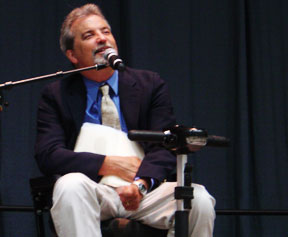
Christopher Klicka, senior legal counsel with the Home School Legal Defense Association, told parents gathered for a home-school convention in Lansing that, “Our rights are at risk. Our values are at risk. We need to be ready and willing to fight.”

Speaking at a home-school conference sponsored by the Information Network for Christian Homes, Christopher Klicka said that while the convention calls for safeguards against childhood prostitution and slavery - "and we're already opposed to that" - it also calls for children's rights to freedom of religion, expression, privacy, education and access to media.

"They have the right to watch TV," Klicka said, tongue in cheek, as parents in the audience sighed.

Klicka is senior counsel with the Home School Legal Defense Association, a Virginia- based firm that specializes in home-school law, policy and legislation. His keynote address was part of a two-day series of lectures and workshops that drew about 2,000 Michigan home-school parents and children to the Lansing Center in May.

In an overview of home-school legal issues, Klicka told parents to be ready to contact legislators to protest ratifying the U.N. treaty as well as to prevent any changes to the federal Keeping Children and Families Safe Act. However, he said, parents should push for adoption of a parental rights amendment to the U.S. Constitution.

Even in Michigan, where home-school protections rank among the best in the country, Klicka said he regularly receives phone calls from parents who say they have been contacted by truant officers, social workers or other authorities with demands for access or information.

"Your rights as parents are worth fighting for," he said.

The United Nations General Assembly adopted the Convention on the Rights of the Child in 1989 and opened it for signatures and ratification by the world's nations. The United States has signed but not ratified the convention, a fact that Klicka attributed partly to pressure from home-schoolers. He said he expects the 54-article treaty to receive renewed attention under the Obama administration.

"We've got to make sure that this doesn't get ratified. We did this once before," he said.

The treaty calls on participating nations to ensure that children's rights are protected and to submit regular progress reports to the Committee on the Rights of the Child, but Klicka said existing U.S. law is sufficient to protect children here.

According to an April report by the Congressional Research Service, U.S. citizens who support the treaty generally point to the need to protect children from government intrusion and abuse, while opponents say it undermines parental rights and could weaken U.S. sovereignty.

Klicka focused on the parental rights arguments, saying that the convention language would give authorities a new way to bring legal action against home-schoolers in cases that essentially puts the parent's lifestyle or beliefs on trial.

"It's not the child that's going to exercise it (treaty rights). It's the social worker," he said.

He cited his association's work in West Virginia as evidence of legal action based on lifestyle.

In that state, lawyers can attend continuing education courses that make them eligible to represent children in cases involving guardianship and child welfare, he said. As part of the coursework, they are taught how to identify abusive parents.

In one class, he said, the instructor told the attorneys that potential abusers include parents who are church deacons, parents who "use Scripture to control their kids," or parents who restrict their children's freedom.

"She described perfectly you and me," Klicka said. "When we (HSLDA) saw it, we went to the West Virginia Supreme Court and they pulled it ... That's what we're faced with."

In a related issue, Klicka said home-schoolers should make sure Congress doesn't weaken provisions in the federal Keeping Children and Families Safe Act that protect families from nuisance investigations based on anonymous tips. While the act is intended to prevent child abuse and help abuse victims, it once led to thousands of cases in which child welfare workers demanded access to home-schools without stating a reason, as well as to interview children outside their parents' presence, Klicka said.

The act was later amended to require workers to state the reason for their visit at first contact, thus giving parents the opportunity to deny entry without a legal warrant.  Another amendment required that workers be trained in citizens' Constitutional protection against unreasonable search and seizure.

"These aren't 'bad' families being turned in," Klicka said. "It's just regular home-schools."

Even in Michigan, where home-school protections rank among the best in the country, Klicka said he regularly receives phone calls from parents who say they have been contacted by truant officers, social workers or other authorities with demands for access or information.

Klicka commended U.S. Rep. Pete Hoekstra, R-Michigan, now a Michigan gubernatorial candidate, for introducing the Parents' Rights Constitutional Amendment to Congress. The amendment would recognize the fundamental right of parents to direct their child's upbringing, he said.

"It's a battle," Klicka said, acknowledging the lengthy process that amending the Constitution requires, "but it's something we can do on the offense."

Well known in home-school circles, Klicka received a standing ovation from the hundreds of people in the audience as he discussed how multiple sclerosis has affected his work and also recounted stories from the early years of Michigan homeschooling.

In addition to Klicka, the INCH convention hosted more than 40 speakers on topics ranging from learning disabilities to math instruction to typical home-school challenges.

More than 100 vendors staffed booths at the event, selling curriculum and classroom goods, and handing out information on summer camps, sports leagues and field trip destinations.

Liz and Dave Rider, home-school parents from Dewitt, told Michigan Education Report that the convention is motivational as well as practical. With four children ranging in age from 11 to 17, one of her challenges is to adapt her teaching style to match each child's learning style, Liz Rider said.

Meanwhile, Dave Rider is Scoutmaster of a home-school Boy Scout troop in the Lansing area.

"It's a full life in homeschooling," he said.

#####

Lorie Shane is the managing editor of the Michigan Education Report, the Mackinac Center’s education policy journal. Permission to reprint in whole or in part is hereby granted, provided that Michigan Education Report is properly cited.

Related Topics: Education, Home Schooling
Michigan Education Daily
"Public schools would avoid most of a $127 per-pupil cut in December, but likely face deeper cuts in the future, if the state Legislature agrees to spend education stimulus dollars this year instead of next." >>
"Responding to potential state aid cuts, Grand Ledge Public Schools administrators have proposed closing two elementary buildings, eliminating 53 positions, ending high school bus service, downsizing sports and band programs and seeking $558,000 in employee concessions." >>
"Five of seven Romeo Community Schools board members have been named in two separate recall efforts, with a school closing and privatization as key issues." >>
"Pontiac School District teachers were to hand out Halloween candy in front of district schools Saturday as part of a larger effort to entice parents and students back to the district." >>
"An Ann Arbor "community standards officer" took down anti-school millage signs in front of a township residence, only to learn that he was outside his jurisdiction." >>
"More students have signed up for reduced-cost meals in Muskegon-area public schools, likely reflecting parental unemployment but also because students don't know any more who among them gets free lunch." >>
"Rather than placing all public employees in a single health care pool, a west Michigan school superintendent suggests the state save money by capping the amount governmental units can pay for health care plans, or by requiring employees to pay a percent of their health insurance premium." >>
User Comments
I agree this is a change worth making. I describe some of the uneven effects of the idea on my blog at http://rickolson.blogspot.com/2009/08/statewide-health-insurance-plan-for.html which you may also wish to read.

The devil will be in the details, so this is one we will need to monitor closely.

Rick Olson from Saline, former school Business Manager >>

Nowadays, saving money is very crucial and properly investing the money can keep you and your family away from the effect of the financial crisis. The sad news is that a lot of the options for short term funding have been drying up. Short term funding is a necessary thing to have around, and going through traditional channels such as banks isn't an option for a lot of people anymore – basically it's only open to Ken Lewis. Installment loans are an option, but some people, including senior citizens, have been thinking about raiding their retirement fund. Getting into your pension retirement plan or 401(k) funds is the last thing you want to do if you don't qualify for any withdrawals yet. The penalties are substantial, and you'll end up needing installments loans to pay them if you use retirement funds for <a rev="vote for" title="Installment Loans Reliable Option As 401(k)s are Dwindling" href="http://personalmoneystore.com/moneyblog/2009/05/17/installment-loans-reliable-option-401ks-dwindling/">short term funding</a>.


>>
I AGREE >>
Godfrey-Lee on the west side of the state has been running all-day, every-day kindergarten for several years. >>
We have a problem in Detroit Public School, their system had cash flow problem for years now. And honestly it getting worst in terms in progression with more children leaving to charter their schools almost every year. The state decided to give the Detroit school districts cash advance of $70 million so they would meet the schools expenses, as well as payment for teachers. Robert Bobb, the newly appointed emergency financial manager, requested the funds early in order for him to get the house in order before he had to start panicking. President Obama has been giving out large sums of money for troubled school districts, perhaps that’s where a generous portion of the aid came from. Getting Detroit Public Schools in working order is a worthy cause.

LINK TO READ FOR MORE INFO:
http://personalmoneystore.com/moneyblog/2009/03/10/state-advance-detroit-public-schools-70m/


>>
I am all for school choice and think its great that charters are finally moving forward. However, I'm wondering if the research accounts for a playing field that is not level. I can't take my school buildings and move them anywhere I want, nor can I simply slap up a pole building and make it a school. If anything, public schools need less state regulation and oversight so we can play by the same minimal rules charters do. If you want public schools to compete to improve, remove the barriers to doing so. I will gladly except less funding per pupil if the playing field is level.
>>
The purpose is to encourage non excercising children to excercise but my daughter's highschool gave her an improper body fat percentage and made my healthy daughter who trains 20 hours a week in tap jazz and ballet believe she was overweaghit instead of a person with muscles.
I believe the public schools do not have the right to make the diagnoses with these kids because they are using one measurement and recording it from their arms that they have a certain percetnage of body fat with one arm caliper test.
Does any one have feed back?
>>
Specifically, 81 percent of students in religiously affiliated schools and 82 percent of students in other private schools have parents who report being "very satisfied" with their schools, compared to 55 percent of students in assigned public schools and 63 percent of students in chosen public schools.

High levels of satisfaction among private school parents also extend to opinions about their children's teachers, academic standards of the school, order and discipline at the school, the amount of homework assigned, and interactions with school personnel.

http://fitt.in >>
Treatment centers offer <A HREF=http://www.teenageproblems.net/>struggling children treatment </A> in effective and real sense. Center provides expert and professional medical expertise that have years of treatment experience. Center develops spiritual qualities in youths. They encourage teens to become descent.

http://www.teenageproblems.net/
>>
For me, either public or private could give good education to students. It really doesn’t matter whether you are in public or private school as long as you are studying and obtaining education, and providing that you can afford the expenses. One of the key ingredients to the success of a modern nation is education. As Americans emerge from the afterglow of the recent presidential elections and president-elect Obama prepares to take the reins of the country, education is a topic on the minds of many. What will he do to improve the lot of students and teachers in America? According to an article at The Apple, Obama’s first order of business when it comes to education will be to look at No Child Left Behind. He doesn’t want to scrap the program, but he does want to reform it, particularly when it comes to standardized testing. He does not support preparing students all year to “fill out bubbles.” Referencing schools, both Obama and vice president-elect Joe Biden support charter schools, as long as they perform up to standard. Teachers at charter schools and others are pleased with Obama's incentives like Teacher Service Scholarships and various pay rewards – this will certainly be a great help. Furthermore, part of the president-elect’s main concern is to boost Early Head Start programs and provide tax credit for college education. The course to repair faith in the American educational system through these ideas and more will definitely lead to the kind of credit repair the country needs. Click to learn more about <a title="What is Credit Repair?" href="http://personalmoneystore.com/moneyblog/what-is-credit-repair/">Credit Repair</a>. >>