Search
Login
Register

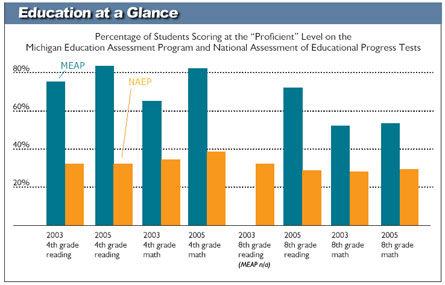
Education at a Glance

Wed., September 6, 2006

Source: Michigan and U.S. Departments of Education

Michigan Education Daily
"Bay County area schools should conduct school board elections jointly with general elections as a way to save money and have more representative voter turnout." >>
"Now three years old, the Kalamazoo Promise has had mixed results in its mission to send Kalamazoo Public Schools graduates to college." >>
"Grand Rapids and Holland public schools are reporting higher numbers of homeless students than last year and expect the figures to grow." >>
"Nineteen Detroit Public Schools teachers are running for election to leadership slots in the Detroit Federation of Teachers union on a school reform platform, according to The Detroit News. The teachers want to open their own charter school modeled after the Los Angeles Green Dot Schools." >>
"Teachers in Gaylord Community Schools have voted to replace the Michigan Educational Special Services Association with AmeraPlan as a third-party insurance administrator, saving the district about 25 percent on health care costs." >>
"A Spanish language teacher quit her job at Michigan Collegiate High School amid allegations that she had a sexual relationship with a 16-year-old male student." >>
"Wyandotte Public Schools is attracting attention statewide for its 90 percent pass rate among algebra II students." >>
User Comments
Testing is not the answer. All it does is give the "teacher" a basis for determining a grade. And, we all know that grading and grades are circumspect. Rather, a more true measure of learning is when the learner (i.e., the "student" using traditional and aniquated terminology and stereotyping) wants to know more about a topic or issue. This expression of desire for more is an affirmation that the learner has mastered current concepts and material and now wants to move on. In this scenario no test nor grade is necessary. What should be necessary is for the provider (i.e., the "teacher") to have the next level or dimension of concepts and materials readily available to present and apply once the learner expresses the desire to move on.

What we need is a system that is designed to cater to this basal learning behavior and can be applied in real time. Take a look at the definitive treatment "Education in America -- What's to Be Done?" developed by Trigon-International. This commission report presents an end-to-end solution that is actionable and affordable. >>
$400 K, try $400 million >>
Thank you to Lorie Shane and Marcie Lipsitt for blowing off the cover, exposing one of Michigan's "dirty secrets."

As the parent of a child with special needs in Michigan, it's been an uphill battle since day one to get the APPROPRIATE services for my child. Sadly, the bar is held too low for our kids. Upon graduating, if the student is not capable of attending college, he/she is warehoused into post-secondary settings where formal academics are not offered. Perhaps if students had gotten proper academics when younger- taught by highly qualified teachers- many would have had the opportunity to move on and continue formal academics like their non-disabled peers, rather than be expected to dust shelves and bag groceries their whole lives.

Michigan's special eduation has and continues to fail our children.

>>
As a parent I see the value of a teacher with knowledge of both special ed methods and the subject matter. Do enough of them exist to go around? My guess is that many teachers who concentrated their schooling and training on special ed took fewer courses in subject matter (English, Mathematics, Science, etc.). There are limits on course load, number of years in college, and student finance.

As much as we want the best for every person, we are not going to have six teachers each an expert in their subject matter per one pupil. So in this world of limited resources, each person and our society have to decide how to use the resources we have. Hopefully a successful balance of flexibility and accountability can produce the desired results: educated children with the capacity to think and the ability to learn. >>
Michigan High School & the University deliver quality education to its
students & has maintained its standard with good caliber. The courses offered by the Michigan institutes are versatile and for future progress of the society and the students, it further enhances them to become excellent citizens!!
---------------------------
Carol
<a href="http://http://www.treatmentcenters.org/michigan">Michigan Treatment Centers</a>
>>
Thank you for your comments. I would be honored and proud to go to any school district or meeting to stand up for your/our children!! Just EMail me and I will be there or call me anytime at 616-8474282
Thank You, Dr Jack Grenan Educator and Cancer Survivor >>
Parents and teachers have not had a voice. The waivers used have allowed administrators of various Michigan schools to plunk in 20 - 25 students in a classroom of students with learning disabilities. As a special education teacher, I find it very difficult to meet the individual learning objectives of that many students. >>
This article presents excellent information. As the parent of a child with a disability I advocate for my son. Currently, there is no one to speak for all the children with disabilities in Michigan. There is no transparency of government. The position of State Superintendent is a dictatorship with the power to make all the decisions. As a parent, I cannot voice my concerns by voting. >>
Ferndale High School in Ferndale, Michigan succeeded in correcting the mistaken reporting of the Johns Hopkins University report that had included it as a "dropout factory" with poor "promoting power." The University researchers have acknowledged that Ferndale High School does not belong in this category and removed the school from the list because of the school district's high outward mobility (more students move out than move in during high school.). The high school has a three-year promoting power ration of 77% rather than the 50% reported in the Associated Press in October 2007, with the Class of 2006 having a 91% promoting power. Please visit Johns Hopkins' website for more clarification to see the "Schools Removed from the List of Weak Promoting Power High Schools: http://web.jhu.edu/CSOS/images/Removed_from_List_5_14_08.pdf .

Also, visit www.ferndaleschools.org for info about the school district. >>
So you're not going to admit an anti-MESSA bias?

*wink* >>