Search
Login
Register

There's no place like home school

Over a million students now part of "fastest growing trend in education"

Wed., January 10, 2001

When asked where their school is, an ever-increasing number of American students are replying, "Home."

Nastassja and Nikita Kotlensky are just two of the many thousands of Michigan children for whom home is not just where the heart is, but also where the classroom is.

Their mother, Terry, who recently was featured in The Detroit News, says she began home schooling Nastassja, 11, because public schools weren't meeting her child's needs. She found home schooling to be the best fit for Nastassja and Nikita, 8, allowing each child to pursue individual academic and extracurricular interests.

"It's pretty neat to see your kids explore their interests," Terry told The News. "It's very rewarding to see what their accomplishments are. Nikita's never been to school. She is a grade level ahead. They are not held back by others."

Home schooling is, in fact, "arguably the fastest growing trend in education," according to the Oct. 10, 2000, Christian Science Monitor. Growing at an estimated 15 percent each year, the home schooling population now comprises approximately 3 percent of the U.S. student population, or more than 1.2 million students across the country.

Why is home schooling so popular? Many parents who decide to home school say they do so because they believe they can provide a better education for their children than public or private schools offer. Others voice concerns over school safety and whether the special needs of their children will be met in the typical school setting. Home schooling, they say, gives them an opportunity to tailor curricula to their children's interests, incorporate religious teaching, and closely monitor what their children are learning.

Critics of home schooling raise questions about the competency of parents who are not certified teachers and wonder if children have ample opportunities to "socialize" with others outside of their families.

The home school movement takes these criticisms seriously. Over the years, a variety of local, state, and national associations have popped up to provide support, information, and "socialization" opportunities for home-schooling families like the Kotlenskys. Many of the groups offer curriculum guidance, extracurricular activities, sports leagues, and group classes for home-schooling families. One of Michigan's home-schooling associations, Information Network for Christian Homes (INCH), offers links to dozens of regional home schooling organizations and events on their web site, www.inch.org.

As for home-schooling parents' competency, research suggests that the individualized attention parents are able to give their children and the independence of the home-school academic program seem to overcome the fact that most parents aren't certified teachers. The Washington Times reported earlier this year that home-schooled students scored higher than their traditionally educated peers on the ACT, one of the nation's two major college-entrance exams, for the third year in a row. The average ACT assessment score was 21 nationally, but home-schooled students scored an average of 22.8.

Research from the Home School Legal Defense Association (HSLDA) also shows that home-schooled students outperform their public school peers. The HSLDA online publication, "Home Education Across the United States," notes that home schoolers average 30 to 37 percentage points above their public school peers across all subjects, according to standardized national academic achievement test data.

HSLDA research also shows that home schoolers perform well regardless of parents' education levels, household income, or race. In fact, home schooling has been shown to significantly eliminate the disparity between white and minority achievement scores.

But perhaps the most striking statistic in the HSLDA data shows that home schoolers spend under $1,000 per student each year, yet attain an average 85th percentile ranking on standardized test scores. Public schools spend, on average, over $5,000 per student, attaining only a 50th percentile ranking on the same tests.

Many recent events also have encouraged the home-schooling movement and verified the growing popularity of the practice across the country. This year, the nation's first college for home schoolers, Patrick Henry College, launched classes in Virginia, and the popular Internet retailer Amazon.com announced the creation of an online store for home schooling families.

Although state laws and regulations on home schooling vary, it is currently legal in all 50 states. Some states require home schoolers to register with the state's Department of Education, while others have few regulations on families who choose to home school. Currently, Michigan's home-schooling laws are liberal, leaving parents with complete control over curriculum. Michigan does not require parents to submit proof of teacher certification, attendance, or testing to the Department of Education.

For students and parents in Michigan and across the country, home schooling is becoming an increasingly attractive option. HSLDA provides more information on home-schooling laws, news, and organizations at its web site, www.hslda.org.

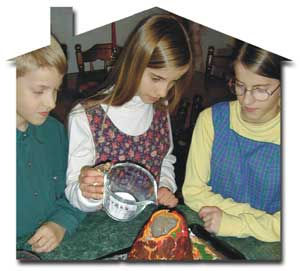
Isaiah, Melissa, and Heather Beerbower of Midland put the finishing touches on their home science project. The state does not track how many students are home-schooled in Michigan, but estimates place the number at over 55,000.
Michigan Education Daily
"Bay County area schools should conduct school board elections jointly with general elections as a way to save money and have more representative voter turnout." >>
"Now three years old, the Kalamazoo Promise has had mixed results in its mission to send Kalamazoo Public Schools graduates to college." >>
"Grand Rapids and Holland public schools are reporting higher numbers of homeless students than last year and expect the figures to grow." >>
"Nineteen Detroit Public Schools teachers are running for election to leadership slots in the Detroit Federation of Teachers union on a school reform platform, according to The Detroit News. The teachers want to open their own charter school modeled after the Los Angeles Green Dot Schools." >>
"Teachers in Gaylord Community Schools have voted to replace the Michigan Educational Special Services Association with AmeraPlan as a third-party insurance administrator, saving the district about 25 percent on health care costs." >>
"A Spanish language teacher quit her job at Michigan Collegiate High School amid allegations that she had a sexual relationship with a 16-year-old male student." >>
"Wyandotte Public Schools is attracting attention statewide for its 90 percent pass rate among algebra II students." >>
User Comments
Testing is not the answer. All it does is give the "teacher" a basis for determining a grade. And, we all know that grading and grades are circumspect. Rather, a more true measure of learning is when the learner (i.e., the "student" using traditional and aniquated terminology and stereotyping) wants to know more about a topic or issue. This expression of desire for more is an affirmation that the learner has mastered current concepts and material and now wants to move on. In this scenario no test nor grade is necessary. What should be necessary is for the provider (i.e., the "teacher") to have the next level or dimension of concepts and materials readily available to present and apply once the learner expresses the desire to move on.

What we need is a system that is designed to cater to this basal learning behavior and can be applied in real time. Take a look at the definitive treatment "Education in America -- What's to Be Done?" developed by Trigon-International. This commission report presents an end-to-end solution that is actionable and affordable. >>
$400 K, try $400 million >>
Thank you to Lorie Shane and Marcie Lipsitt for blowing off the cover, exposing one of Michigan's "dirty secrets."

As the parent of a child with special needs in Michigan, it's been an uphill battle since day one to get the APPROPRIATE services for my child. Sadly, the bar is held too low for our kids. Upon graduating, if the student is not capable of attending college, he/she is warehoused into post-secondary settings where formal academics are not offered. Perhaps if students had gotten proper academics when younger- taught by highly qualified teachers- many would have had the opportunity to move on and continue formal academics like their non-disabled peers, rather than be expected to dust shelves and bag groceries their whole lives.

Michigan's special eduation has and continues to fail our children.

>>
As a parent I see the value of a teacher with knowledge of both special ed methods and the subject matter. Do enough of them exist to go around? My guess is that many teachers who concentrated their schooling and training on special ed took fewer courses in subject matter (English, Mathematics, Science, etc.). There are limits on course load, number of years in college, and student finance.

As much as we want the best for every person, we are not going to have six teachers each an expert in their subject matter per one pupil. So in this world of limited resources, each person and our society have to decide how to use the resources we have. Hopefully a successful balance of flexibility and accountability can produce the desired results: educated children with the capacity to think and the ability to learn. >>
Michigan High School & the University deliver quality education to its
students & has maintained its standard with good caliber. The courses offered by the Michigan institutes are versatile and for future progress of the society and the students, it further enhances them to become excellent citizens!!
---------------------------
Carol
<a href="http://http://www.treatmentcenters.org/michigan">Michigan Treatment Centers</a>
>>
Thank you for your comments. I would be honored and proud to go to any school district or meeting to stand up for your/our children!! Just EMail me and I will be there or call me anytime at 616-8474282
Thank You, Dr Jack Grenan Educator and Cancer Survivor >>
Parents and teachers have not had a voice. The waivers used have allowed administrators of various Michigan schools to plunk in 20 - 25 students in a classroom of students with learning disabilities. As a special education teacher, I find it very difficult to meet the individual learning objectives of that many students. >>
This article presents excellent information. As the parent of a child with a disability I advocate for my son. Currently, there is no one to speak for all the children with disabilities in Michigan. There is no transparency of government. The position of State Superintendent is a dictatorship with the power to make all the decisions. As a parent, I cannot voice my concerns by voting. >>
Ferndale High School in Ferndale, Michigan succeeded in correcting the mistaken reporting of the Johns Hopkins University report that had included it as a "dropout factory" with poor "promoting power." The University researchers have acknowledged that Ferndale High School does not belong in this category and removed the school from the list because of the school district's high outward mobility (more students move out than move in during high school.). The high school has a three-year promoting power ration of 77% rather than the 50% reported in the Associated Press in October 2007, with the Class of 2006 having a 91% promoting power. Please visit Johns Hopkins' website for more clarification to see the "Schools Removed from the List of Weak Promoting Power High Schools: http://web.jhu.edu/CSOS/images/Removed_from_List_5_14_08.pdf .

Also, visit www.ferndaleschools.org for info about the school district. >>
So you're not going to admit an anti-MESSA bias?

*wink* >>